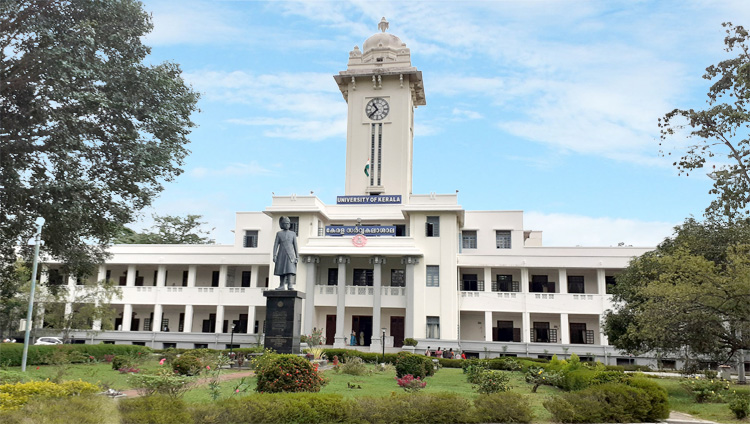
Ph.D. in Economics from Kerala University: Complete Guide for Professionals
Introduction about Ph.D. in Economics at Kerala University
Kerala University stands as a beacon of academic excellence in South India, offering a rigorous Ph.D. in Economics that blends theoretical depth with real‑world relevance. Tailored for seasoned professionals, the programme empowers scholars to investigate pressing economic challenges, influence policy, and become thought leaders in academia, research institutions, and industry. With a vibrant research ecosystem and world‑class faculty, Kerala University nurtures innovative thinking and provides a launchpad for a distinguished career.
Eligibility Criteria for Ph.D. in Economics at Kerala University
- Master’s degree (or equivalent) in Economics, Applied Economics, or a related discipline with at least 55% marks (or 5.5 CGPA) for general category candidates.
- Candidates holding a NET/UGC-JRF qualification are exempted from the entrance examination.
- Minimum of two years of relevant professional experience (teaching/research) is preferred but not mandatory.
- Age limit: No upper age restriction; however, candidates must satisfy the university’s physical fitness standards.
Entrance Exam for Ph.D. in Economics at Kerala University
The university conducts a comprehensive written test and personal interview to assess analytical ability, research aptitude, and subject mastery. The exam pattern typically includes:
- Paper‑I (Written Test): 100 marks; objective and descriptive questions covering micro‑economics, macro‑economics, econometrics, and development economics.
- Paper‑II (Interview): 50 marks; evaluation of research proposal, academic background, and communication skills.
Successful candidates are notified through the official portal and invited to submit a detailed research proposal.
Fee Structure for Ph.D. in Economics at Kerala University
| Component | Amount (INR) | Notes |
|---|---|---|
| Application Fee (Online) | 1,500 | Non‑refundable |
| Registration Fee (First Year) | 10,000 | Payable after admission offer |
| Annual Tuition & Laboratory Charges | 12,000 | Same each academic year |
| Examination/Thesis Submission Fee | 5,000 | One‑time payment |
| Miscellaneous (Library, Sports, etc.) | 2,000 | Approximate |
| Total (Approx.) | 30,500 | Excluding scholarships & grants |
Admission Process for Ph.D. in Economics at Kerala University
- Visit the official Kerala University Ph.D. portal and create an account.
- Fill out the online application form, upload scanned copies of academic certificates, and pay the Rs. 1,500 application fee.
- Submit a concise research proposal (max 1500 words) outlining objectives, methodology, and expected contributions.
- Appear for the entrance examination (or submit NET/JRF score for exemption).
- Successful candidates are called for a personal interview.
- Upon clearing the interview, receive an admission offer letter, pay the registration fee, and begin registration for courses.
Ph.D. Subjects and Specializations in Economics at Kerala University
Students can tailor their doctoral studies to emerging fields, including:
- Development Economics & Poverty Alleviation
- Environmental & Resource Economics
- International Trade and Finance
- Labor Economics and Human Capital
- Econometrics and Quantitative Methods
- Health Economics
- Public Policy and Governance
Research Areas in Economics at Kerala University
The university’s research centres focus on high‑impact areas that align with global priorities:
- Economic Implications of Climate Change
- Digital Economy and FinTech Innovations
- Inclusive Growth Strategies for Kerala and South‑India
- Agricultural Economics and Food Security
- Urbanization, Housing, and Infrastructure Economics
- Behavioural Economics and Decision Sciences
Documents Required for Ph.D. in Economics at Kerala University
| Document | Format | Remarks |
|---|---|---|
| Completed Online Application Form | PDF/Online | Submitted via university portal |
| Mark Sheets & Degree Certificates (M.A./M.Sc.) | Scanned PDFs | Originals to be produced on request |
| Research Proposal (max 1500 words) | Word Document | Must include objectives, literature review, methodology |
| Curriculum Vitae (Academic) | Highlight publications and work experience | |
| NET/UGC‑JRF Scorecard (if applicable) | Exemption from entrance test | |
| Two Recent Passport‑size Photographs | JPEG/PNG | White background |
| Proof of Identity (Aadhar/Passport) | Government‑issued ID |
Kerala University Ph.D. Syllabus for Economics
The syllabus is structured into core modules and elective specializations, spanning four years:
- Year 1: Advanced Micro‑economics, Advanced Macroeconomics, Research Methodology, Econometric Techniques.
- Year 2: Specialization Courses (e.g., Development Economics, Environmental Economics), Seminar Participation, Comprehensive Examination.
- Year 3: Data Collection & Analysis, Drafting of Chapter 1 & Chapter 2, Publication of a research paper.
- Year 4: Thesis Writing, Submission, Defense, and Publication of final research outcomes.
How To Apply for Ph.D. in Economics at Kerala University
Follow these concise steps to secure your place:
- Check the official notification page for the latest admission cycle dates.
- Gather all required documents (as listed above) in PDF format.
- Register on the university’s admission portal and complete the online application.
- Upload your research proposal and pay the Rs. 1,500 application fee.
- Monitor your email for exam schedule, results, and interview invitations.
- Upon selection, submit the registration fee and enroll in the first‑year courses.
Career Scope and Job Opportunities After Ph.D. in Economics from Kerala University
A doctorate from Kerala University opens doors to diverse, high‑impact careers:
- Academic Positions: Assistant Professor, Associate Professor, or Faculty Head at universities and research institutes.
- Policy & Research Institutes: Economist or Senior Analyst at RBI, NITI Aayog, World Bank, IMF, and think‑tanks.
- Corporate Sector: Chief Economist, Business Analyst, or Strategy Consultant in multinational corporations and financial services firms.
- International Organizations: Research Fellow or Programme Officer in UN agencies, Asian Development Bank, etc.
- Entrepreneurial Ventures: Founder of economic advisory firms or data‑analytics startups.
Graduates also benefit from strong networking opportunities, conferences, and publication platforms that boost visibility in the global economics community.
Scholarship for Ph.D. in Economics at Kerala University
Kerala University offers several merit‑based and need‑based scholarships to alleviate financial constraints:
- University Merit Scholarship: Up to 50% tuition waiver for top 10% of admitted candidates.
- Kerala State Research Fellowship: Annual stipend of Rs. 15,000 for the duration of the programme.
- External Grants: Eligibility for Thesis and Dissertation Writing Services grants, UGC‑JRF, and CSIR‑NET funding.
- Industry‑Sponsored Scholarships: Partnerships with banks and consulting firms providing project‑based funding.
FAQs Regarding Ph.D. in Economics at Kerala University
- 1. Is the NET qualification mandatory?
- No. NET/UGC‑JRF candidates are exempted from the entrance test, but they must still submit a research proposal and attend the interview.
- 2. How long does it take to complete the Ph.D.?
- The programme is designed for a maximum of four years, subject to satisfactory progress in coursework and research.
- 3. Can a working professional enroll part‑time?
- Kerala University primarily offers full‑time Ph.D. programmes. However, candidates with employer sponsorship may apply for a flexible schedule after approval from the Dean.
- 4. What support is available for data analysis?
- The university’s statistics lab provides access to SPSS, Stata, R, and Python. Additionally, you can avail professional Research Data Analysis Services if external expertise is needed.
- 5. Are there opportunities to publish during the Ph.D.?
- Yes. Students are encouraged to submit at least one paper to indexed journals; the university also offers Research Paper Writing Services to refine manuscripts.
- 6. How is the final thesis evaluated?
- The thesis undergoes a rigorous internal review, followed by a public defense before a panel of experts. Successful candidates must also submit a plagiarism‑checked electronic copy.
- 7. Is there assistance with questionnaire design?
- Certainly. The university’s research








