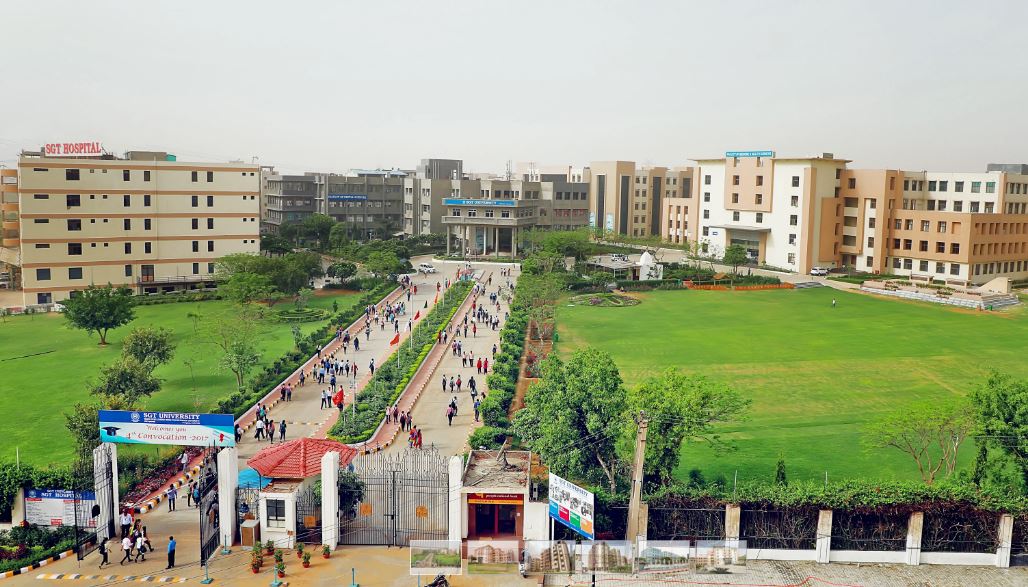
Ph.D. in Education from Shree Guru Gobind Singh Tricentenary University: Eligibility, Entrance Exam, Fee Structure, Admission Process, Subjects, Research Areas, Syllabus, Scholarship & Career Scope
Introduction about Ph.D. in Education at Shree Guru Gobind Singh Tricentenary University
Embarking on a doctoral journey in education at Shree Guru Gobind Singh Tricentenary University opens doors to pioneering research, transformative leadership, and impactful policy formulation. The university?s Ph.D. program is meticulously crafted for seasoned educators, academic professionals, and researchers who aspire to influence the future of teaching, learning, and educational governance on a global scale.
The curriculum balances rigorous theoretical frameworks with practical application, fostering a scholarly environment where critical thinking, innovation, and interdisciplinary collaboration thrive. Graduates emerge as thought leaders equipped to drive reform, design evidence?based curricula, and spearhead groundbreaking studies that shape the educational landscape.
Eligibility Criteria for Ph.D. in Education at Shree Guru Gobind Singh Tricentenary University
Prospective candidates must satisfy the following minimum requirements:
- Master?s degree in Education or a closely related discipline (e.g., Curriculum Studies, Educational Psychology) from a recognized university with at least 55% aggregate marks (or equivalent CGPA).
- Alternatively, a Bachelor?s degree with 60% and a valid NET/SLET/SET qualification.
- Demonstrated research aptitude through a research proposal, publications, or professional experience in the education sector.
- Proficiency in English (minimum IELTS 6.0 or TOEFL iBT 80, if the previous medium of instruction was not English).
Eligibility is assessed holistically, emphasizing academic excellence, research potential, and professional background.
Entrance Exam for Ph.D. in Education at Shree Guru Gobind Singh Tricentenary University
The university conducts its own entrance examination, designed to evaluate candidates? conceptual understanding, analytical skills, and research orientation.
- Paper I ? Research Aptitude (100 marks): Objective questions covering research methodology, statistics, and educational theory.
- Paper II ? Subject Knowledge (100 marks): Descriptive questions focusing on core areas such as curriculum development, pedagogical strategies, and educational leadership.
- Duration: 3 hours per paper.
- Eligibility for exemption: Candidates who have qualified national-level eligibility tests (NET, SLET, SET) are exempted from Paper I.
Preparation resources, sample papers, and exam dates are regularly updated on the university?s official portal.
Fee Structure for Ph.D. in Education at Shree Guru Gobind Singh Tricentenary University
| Component | Amount (INR) |
|---|---|
| Application & Processing Fee | 2,500 |
| Entrance Examination Fee | 4,000 |
| Annual Tuition Fee (per annum) | 45,000 |
| Laboratory & Library Access (per annum) | 7,500 |
| Technology & E?Learning Resources (per annum) | 5,000 |
| Total Estimated Cost (4?Year Program) | 218,000 |
Fee waivers are available for meritorious candidates and those securing national-level scholarships. The university also offers flexible payment plans to ease financial commitment.
Admission Process for Ph.D. in Education at Shree Guru Gobind Singh Tricentenary University
The admission workflow comprises the following sequential steps:
- Online Application: Submit the digital application form with scanned copies of academic transcripts, certificates, and a concise research proposal.
- Document Verification: The admissions committee validates authenticity and eligibility.
- Entrance Examination: Appear for the university?conducted test or submit NET/SLET/SET scores for exemption.
- Interview: Shortlisted candidates are invited for a panel interview to assess research alignment and motivation.
- Final Selection & Offer Letter: Successful applicants receive an official admission letter and details regarding fee payment.
- Enrollment: Complete enrollment by submitting the receipt of fee payment and signing the declaration form.
All deadlines, important dates, and detailed guidelines are published annually on the university?s admissions portal.
Ph.D. Subjects and Specializations in Education at Shree Guru Gobind Singh Tricentenary University
Students can tailor their doctoral research across a spectrum of specialized domains, including:
- Curriculum Design & Evaluation
- Educational Leadership & Policy
- Comparative & International Education
- Instructional Technology & E?Learning
- Special and Inclusive Education
- Educational Psychology & Counseling
- Assessment & Measurement
- Higher Education Management
Inter?disciplinary collaborations with departments such as Sociology, Psychology, and Computer Science broaden research horizons.
Research Areas in Education at Shree Guru Gobind Singh Tricentenary University
The university?s research ecosystem emphasizes contemporary challenges and future?oriented solutions. Prominent research clusters include:
- Digital Pedagogies and AI?Driven Learning Environments
- Equity, Access, and Social Justice in Education
- Teacher Professional Development and Retention Strategies
- Learning Analytics and Data?Driven Decision Making
- Policy Impact Assessment and Educational Governance
- Neuroscience Foundations of Learning
Students are encouraged to partner with international scholars, contribute to peer?reviewed journals, and present findings at global conferences.
For robust support throughout your research journey, consider our Research Data Analysis Services to ensure methodological rigor and statistical accuracy.
Documents Required for Ph.D. in Education at Shree Guru Gobind Singh Tricentenary University
| Document | Details |
|---|---|
| Completed Application Form | Online submission with digital signature |
| Academic Transcripts & Degree Certificates | Originals plus notarized copies |
| Research Proposal (max 1500 words) | Problem statement, objectives, methodology |
| Proof of English Proficiency | IELTS/TOEFL or equivalent |
| NET/SLET/SET Score Card (if applicable) | Original scorecard for exemption |
| Curriculum Vitae (CV) | Academic and professional experience |
| Two Academic References | Letters on institution letterhead |
| Passport?Size Photograph | Recent, color, 2?2 cm |
All documents must be uploaded in PDF format (maximum size 2?MB per file). Incomplete submissions will be rejected without further notice.
Shree Guru Gobind Singh Tricentenary University Ph.D. Syllabus for Education
The doctoral syllabus is structured into three progressive phases:
- Core Foundations (Year?1): Research methodology, advanced statistics, and education theory.
- Specialization Modules (Year?2?3): Choose 2?3 elective courses aligning with your research focus, such as ?Technology?Enhanced Learning? or ?Policy Analysis?.
- Dissertation Phase (Year?3?4): Conduct original research, submit progress reports, and defend the thesis before a distinguished panel.
The syllabus is regularly updated to incorporate emerging topics like








