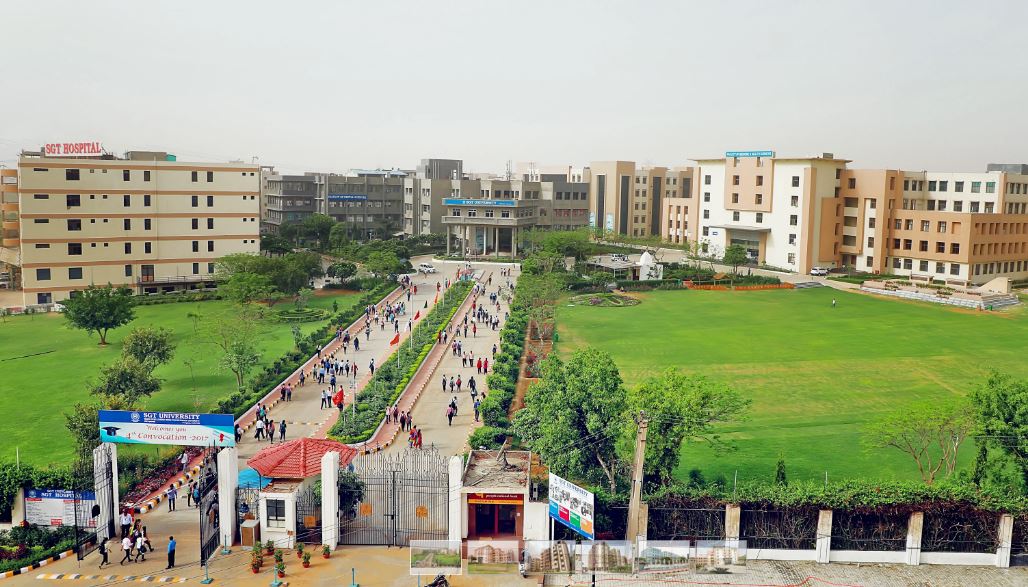
Introduction about Ph.D. in Journalism And Mass Communication at Shree Guru Gobind Singh Tricentenary University
The Ph.D. in Journalism and Mass Communication offered by Shree Guru Gobind Singh Tricentenary University is a pioneering research programme designed for seasoned media professionals, academicians, and aspiring scholars who wish to deepen their expertise and contribute original knowledge to the dynamic field of communication. This doctoral course blends rigorous theoretical frameworks with cutting?edge industry practices, empowering candidates to explore evolving media landscapes, digital storytelling, audience analytics, and policy implications. Graduates emerge as thought leaders, equipped to influence media strategy, shape public discourse, and drive transformative change across global communication ecosystems.
Eligibility Criteria for Ph.D. in Journalism And Mass Communication at Shree Guru Gobind Singh Tricentenary University
Prospective candidates must satisfy the following academic and professional benchmarks:
- A Master?s degree (M.A./M.Sc.) in Journalism, Mass Communication, Media Studies, or a closely related discipline from a recognized university with a minimum aggregate of 55?%.
- Alternatively, a strong research background demonstrated by a published article in a peer?reviewed journal or a professional portfolio showcasing at least 3 years of relevant industry experience.
- Candidates who hold a Ph.D. in a related field (e.g., Sociology, Political Science, Cultural Studies) may apply for a lateral entry, subject to approval by the Academic Council.
- Eligibility for the entrance test (if required) as stipulated by the university?s guidelines.
Entrance Exam for Ph.D. in Journalism And Mass Communication at Shree Guru Gobind Singh Tricentenary University
The university conducts a comprehensive entrance examination to evaluate a candidate?s research aptitude, analytical capability, and domain knowledge. The exam comprises three sections:
- Research Methodology & Statistics ? testing familiarity with qualitative and quantitative techniques.
- Core Journalism & Mass Communication Concepts ? covering media ethics, communication theories, and digital media trends.
- General Aptitude & English Proficiency ? assessing logical reasoning, data interpretation, and academic writing skills.
Candidates scoring above the prescribed cutoff are invited for a personal interview where research proposals are scrutinized. The interview also gauges the candidate?s motivation and alignment with the university?s research vision. Preparation resources such as the university?s Research Paper Writing Services can be invaluable for refining proposal drafts.
Fee Structure for Ph.D. in Journalism And Mass Communication at Shree Guru Gobind Singh Tricentenary University
The fee schedule is structured to accommodate both full?time scholars and working professionals opting for a part?time mode. All fees are payable in Indian Rupees (INR).
| Component | Full?Time (Annual) | Part?Time (Annual) |
|---|---|---|
| Tuition Fee | ? 85,000 | ? 55,000 |
| Library & Laboratory Access | ? 12,000 | ? 12,000 |
| Research Resources & Data Subscription | ? 8,000 | ? 8,000 |
| Examination & Evaluation Charges | ? 5,000 | ? 5,000 |
| Total Annual Fee | ? 110,000 | ? 80,000 |
A one?time registration charge of ? 5,000 is applicable at the time of admission. Scholarships, merit?based waivers, and external funding options can considerably reduce the financial burden for eligible candidates.
Admission Process for Ph.D. in Journalism And Mass Communication at Shree Guru Gobind Singh Tricentenary University
The admission workflow is transparent and consists of the following sequential steps:
- Online Application ? Submit the digital application form through the university portal along with scanned copies of academic transcripts, identity proof, and a brief research synopsis.
- Document Verification ? The admissions office verifies the authenticity of submitted documents and issues a provisional ID.
- Entrance Examination ? Candidates appear for the written test (or submit the qualifying national test scores, e.g., UGC NET, CSIR NET).
- Personal Interview & Proposal Review ? Shortlisted aspirants present their research proposal to a panel of senior faculty members.
- Final Selection & Offer Letter ? Successful candidates receive an official offer letter detailing fee payment deadlines and program commencement dates.
- Enrollment & Orientation ? After fee clearance, students enroll in the first semester and attend a comprehensive orientation covering research ethics, resource access, and mentorship guidelines.
Ph.D. Subjects and Specializations in Journalism And Mass Communication at Shree Guru Gobind Singh Tricentenary University
The doctoral programme offers a flexible curriculum that allows scholars to specialize in emerging and traditional domains, such as:
- Digital Media & Online Journalism
- Media Management & Policy
- Communication Ethics & Law
- Audience Behaviour & Media Psychology
- Investigative Reporting & Data Journalism
- Public Relations & Strategic Communication
- Film, Television, and New Media Studies
- International Communication & Global Media Systems
Students can select a primary specialization while integrating interdisciplinary electives that complement their research trajectory.
Research Areas in Journalism And Mass Communication at Shree Guru Gobind Singh Tricentenary University
Faculty expertise and institutional facilities support a wide spectrum of research foci, including but not limited to:
- Impact of Artificial Intelligence on News Production
- Media Framing of Climate Change and Sustainability
- Digital Disinformation, Fake News, and Fact?Checking Mechanisms
- Social Media Analytics & Audience Engagement Metrics
- Gender Representation in Broadcast Media
- Media Regulation and Policy in Emerging Democracies
- Community Radio and Rural Communication Development
- Cross?Cultural Journalism Practices
Prospective scholars are encouraged to align their dissertation topics with these strategic areas, thereby enhancing relevance and funding prospects.
Documents Required for Ph.D. in Journalism And Mass Communication at Shree Guru Gobind Singh Tricentenary University
A well?organized document set accelerates the verification stage. Applicants must furnish:
| Document | Format | Remarks |
|---|---|---|
| Completed Online Application Form | Signed digitally | |
| Academic Transcripts & Degree Certificates (Post?Graduate) | PDF/Scanned Image | Attested copies |
| Proof of Identity (Aadhaar / Passport) | Valid for the current year | |
| Research Proposal (5?10 pages) | Include objectives, methodology, and literature review | |
| Curriculum Vitae (Academic & Professional) | Highlight publications and media projects | |
| Letters of Recommendation (2) | From senior academicians or industry mentors | |
| Entrance Exam Scorecard (if applicable) | UGC?NET, CSIR?NET, or university?conducted test |
Shree Guru Gobind Singh Tricentenary University Ph.D. Syllabus for Journalism And Mass Communication
The doctoral syllabus is modular, comprising core coursework, research methodology, and dissertation milestones. Key modules include:
- Advanced Communication Theory
- Qualitative & Quantitative Research Methods
- Statistical Software for Media Analytics (SPSS, R, NVivo)
- Media Law, Ethics, and Regulation
- Digital Storytelling & Multimedia Production
- Electives: Data Journalism, Media Economics, Global Press Systems
- Seminar Series: Guest Lectures by Industry Leaders
- Dissertation Research & Publication
Students are expected to publish at least two peer?review








