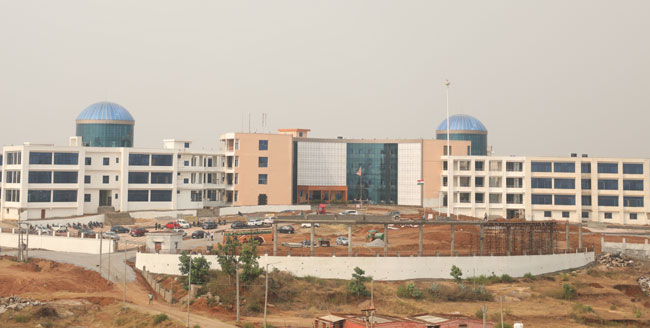
Ph.D. in Physics at Central University of Jharkhand
Introduction about Ph.D. in Physics at Central University of Jharkhand
Embarking on a doctoral journey in physics at the Central University of Jharkhand (CUJ) is more than an academic pursuit; it is a commitment to unravel the mysteries of the universe through rigorous research and innovative thinking. The university’s state‑of‑the‑art laboratories, seasoned faculty, and interdisciplinary collaborations provide the ideal ecosystem for aspiring physicists to transform curiosity into breakthrough discoveries.
CUJ’s Ph.D. programme emphasizes both foundational theory and cutting‑edge applications, ensuring graduates are equipped to contribute to academia, industry, and national research initiatives. Whether your passion lies in quantum mechanics, astrophysics, condensed matter, or computational physics, the university’s flexible curriculum and robust support system empower you to chart a distinctive research trajectory.
Ph.D Admission 2026-2027 & Writing Support Services by Shiksha Research
Eligibility Criteria for Ph.D. in Physics at Central University of Jharkhand
- A Master’s degree (M.Sc.) in Physics or a related discipline with a minimum of 55% aggregate (or equivalent CGPA).
- Candidates holding a Bachelor’s degree (B.Sc.) in Physics with at least 65% aggregate are also considered on a case‑by‑case basis.
- Qualifying scores in national level examinations such as UGC‑NET, CSIR‑NET, GATE (Physics) or equivalent are highly preferred.
- Applicants must possess a strong academic record, demonstrated research aptitude, and proficiency in English.
Entrance Exam for Ph.D. in Physics at Central University of Jharkhand
The university conducts its own entrance test, supplemented by national eligibility criteria. The exam evaluates:
- Core physics concepts and problem‑solving abilities.
- Analytical reasoning and quantitative aptitude.
- Research methodology and academic writing skills.
Candidates who have cleared UGC‑NET, CSIR‑NET, or GATE can obtain direct admission without appearing for the university’s entrance exam, provided they meet the cut‑off marks stipulated by the department.
Fee Structure for Ph.D. in Physics at Central University of Jharkhand
| Category | Annual Fee (INR) | Notes |
|---|---|---|
| General/OBC | 30,000 | Includes tuition, library, and lab usage. |
| SC/ST/PWD | 15,000 | Reduced fee as per government reservation policy. |
| Scholarship/Assistantship Holders | 0 | Full waiver for candidates receiving university or external scholarships. |
Admission Process for Ph.D. in Physics at Central University of Jharkhand
- Online application submission through the university portal.
- Upload of academic transcripts, entrance exam scores, and research proposal.
- Payment of application fee (INR 1,500).
- Verification of eligibility by the Department of Physics.
- Invitation for entrance test or interview (if applicable).
- Final selection based on merit, interview performance, and research potential.
- Offer letter issuance and enrollment formalities.
Ph.D. Subjects and Specializations in Physics at Central University of Jharkhand
The doctoral programme offers a spectrum of specializations, allowing candidates to tailor their research focus:
- Quantum Mechanics & Quantum Information
- Condensed Matter Physics
- Astrophysics & Cosmology
- Particle Physics
- Optics & Photonics
- Computational Physics & Numerical Modelling
- Nanoscience & Materials Engineering
Research Areas in Physics at Central University of Jharkhand
CUJ’s research ecosystem encourages interdisciplinary collaborations across the following cutting‑edge domains:
- Dark Matter and Dark Energy investigations.
- Development of high‑temperature superconductors.
- Laser‑based spectroscopy for material characterization.
- Computational simulations of complex systems.
- Renewable energy technologies involving photovoltaic materials.
- Biomedical physics applications, such as imaging and radiation therapy.
The university also partners with national laboratories and industry leaders, providing doctoral scholars with avenues for joint research projects and technology transfer.
Documents Required for Ph.D. in Physics at Central University of Jharkhand
| Document | Format | Remarks |
|---|---|---|
| Academic Transcripts (10‑12 & Graduation/Master’s) | PDF, Scanned copy | Must be attested |
| Entrance Exam Scorecard (UGC‑NET/CSIR‑NET/GATE) | Original copy preferred | |
| Research Proposal (max 1500 words) | DOCX or PDF | Include objectives & methodology |
| Curriculum Vitae | Highlight publications & projects | |
| Letter of Recommendation (2) | From academicians or industry mentors | |
| Identity Proof (Aadhaar/PAN) | Government‑issued ID |
Central University of Jharkhand Ph.D. Syllabus for Physics
The syllabus is structured to strengthen both theoretical foundations and research competencies:
- Advanced Quantum Theory
- Statistical Mechanics and Thermodynamics
- Mathematical Methods for Physicists
- Research Methodology and Scientific Writing
- Specialized elective courses aligned with the chosen research area
Regular workshops on data analysis, simulation tools, and manuscript preparation supplement classroom learning.
How To Apply for Ph.D. in Physics at Central University of Jharkhand
Follow these steps to submit a successful application:
- Visit the official CUJ admissions portal and create a new user account.
- Fill in personal and academic details in the online application form.
- Upload the required documents (refer to the “Documents Required” table).
- Pay the non‑refundable application fee through net banking or credit card.
- Submit the application and note the generated application number for future correspondence.
- Monitor email for the admit card (if an entrance test is scheduled) or interview invitation.
For detailed guidance on each stage, prospective candidates can refer to the university’s Thesis and Dissertation Writing Services page, which offers insights on preparing a compelling research proposal.
Career Scope and Job Opportunities After Ph.D. in Physics from Central University of Jharkhand
A doctorate in physics opens doors to diverse high‑impact careers:
- University faculty positions (Assistant/Associate Professor).
- Research scientist roles in national labs (e.g., DRDO, ISRO, BARC).
- Data science and quantitative analyst positions in finance and IT sectors.
- Product development and R&D leadership in semiconductor, aerospace, and renewable energy companies.
- Consultancy and policy advisory roles for government science agencies.
- Entrepreneurship in high‑tech startups focusing on quantum computing, nanomaterials, or photonic devices.
The university’s strong alumni network and industry tie‑ups facilitate placement drives, collaborative projects, and post‑doctoral fellowships.
Scholarship for Ph.D. in Physics at Central University of Jharkhand
Financial assistance is available through multiple channels:
- University Merit Scholarships – awarded based on academic performance.
- UGC-JRF (Junior Research Fellowship) and CSIR‑SRF (Senior Research Fellowship) – national level fellowships offering a stipend of INR 31,000 per month.
- External scholarships from private foundations and industry partners.
- Teaching and research assistantships – provide remuneration while enhancing pedagogical skills.
Candidates can enhance their funding prospects by leveraging the Research Data Analysis Services offered by the university’s research support unit, which helps present data‑driven project proposals.
FAQs Regarding Ph.D. in Physics at Central University of Jharkhand
- Q1: What is the duration of the Ph.D. programme?
- A: Typically 3–4 years, contingent on research progress and publication requirements.
- Q2: Is there a minimum number of publications required for completion?
- A: Candidates must submit at least two








