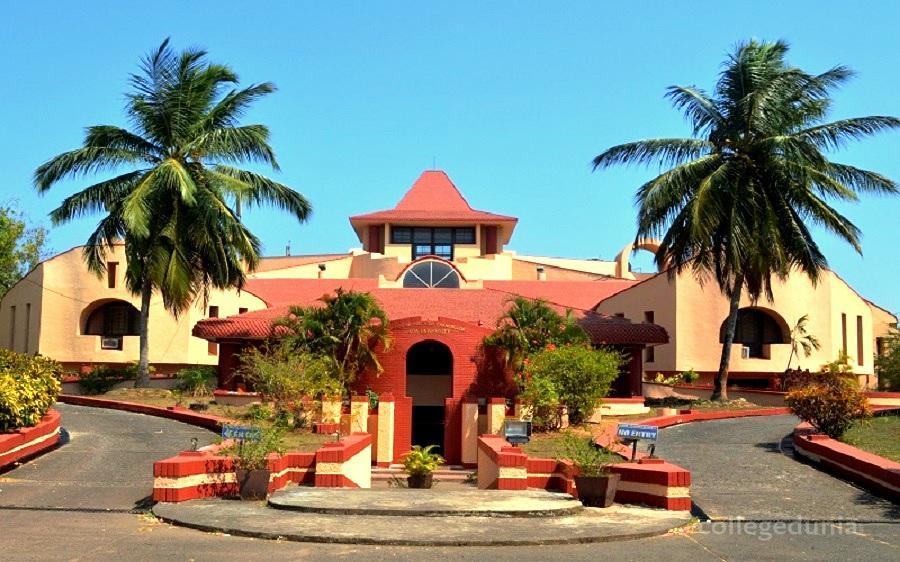
Ph.D. in Physics from Goa University: Eligibility, Entrance Exam, Fee Structure, Admission Process, Subjects, Research Areas, Syllabus, Scholarship & Career Scope
Introduction about Ph.D. in Physics at Goa University
Embarking on a doctoral journey in physics at Goa University opens the door to cutting‑edge research, world‑class mentorship, and a community committed to scientific excellence. The program is designed for professionals who aspire to push the boundaries of knowledge, develop innovative technologies, and become thought leaders in academia or industry. With state‑of‑the‑art laboratories, interdisciplinary collaborations, and a vibrant campus life, Goa University provides an inspiring environment where curiosity transforms into groundbreaking discoveries.
Eligibility Criteria for Ph.D. in Physics at Goa University
Prospective candidates must satisfy the following minimum requirements:
- Master’s degree (M.Sc. or M.Tech.) in Physics or a closely related discipline with at least 55% marks (or equivalent GPA) from a recognized university.
- Relevant research experience, publications, or project work is highly recommended.
- For candidates holding a B.E./B.Tech. in a related engineering field, a minimum of 60% marks in the qualifying degree is required.
- Nationality: Indian citizens or foreign nationals meeting the University’s residency criteria.
- Age limit: No upper age restriction, but candidates should demonstrate the ability to complete the program within the stipulated period.
Entrance Exam for Ph.D. in Physics at Goa University
The entrance assessment is a two‑stage process:
- Written Test – A 100‑minute paper covering advanced topics in classical mechanics, quantum mechanics, statistical physics, and mathematical methods. The test evaluates analytical thinking, problem‑solving skills, and depth of subject knowledge.
- Interview & Research Proposal Presentation – Shortlisted candidates present a concise research proposal and undergo a viva‑voce with the department faculty. The panel assesses research aptitude, originality of ideas, and alignment with ongoing projects.
Applicants can also apply under the PhD Admission Assistance scheme, which provides guidance on preparation strategies and documentation.
Fee Structure for Ph.D. in Physics at Goa University
| Component | Annual Fee (INR) | Notes |
|---|---|---|
| Tuition & Laboratory Charges | ₹ 35,000 | Includes access to core labs and computational facilities. |
| Library & Resource Center | ₹ 5,000 | Full access to digital journals, e‑books, and inter‑library loans. |
| Examination & Evaluation Fee | ₹ 7,000 | Applicable for each semester’s assessment. |
| Miscellaneous (Student Services, ID Card, etc.) | ₹ 3,000 | |
| Total Approximate Cost per Year | ₹ 50,000 |
Admission Process for Ph.D. in Physics at Goa University
The admission cycle follows a systematic procedure:
- Online Application – Fill the digital application form available on the university portal and upload scanned copies of academic transcripts, research proposal, and identification documents.
- Payment of Application Fee – Pay a non‑refundable fee of ₹ 2,500 via net banking or credit/debit card.
- Eligibility Verification – The admissions committee reviews academic credentials and research background.
- Entrance Examination – Sit for the written test at designated test centers.
- Interview & Proposal Defense – Successful candidates are invited for a face‑to‑face interview.
- Final Offer Letter – Admission letter is issued electronically, followed by enrollment formalities.
For candidates seeking personalized guidance, the university collaborates with professional services such as Editing and Proofreading Services to polish research proposals and CVs.
Ph.D. Subjects and Specializations in Physics at Goa University
Students can choose from a wide spectrum of specializations, each aligned with the department’s research strengths:
- Condensed Matter Physics
- Quantum Optics & Photonics
- High Energy & Particle Physics
- Astrophysics & Cosmology
- Computational & Numerical Physics
- Biophysics & Medical Physics
- Nanoscience & Nanotechnology
Research Areas in Physics at Goa University
The department’s research agenda is driven by interdisciplinary collaborations and national funding initiatives. Core research clusters include:
- Materials for Renewable Energy – Development of photovoltaic and thermoelectric materials.
- Quantum Information Processing – Exploration of qubits, entanglement, and quantum communication protocols.
- Atmospheric & Climate Physics – Modeling of monsoon dynamics and coastal aerosol impacts.
- Medical Imaging & Radiation Physics – Advancements in MRI, PET, and radiation therapy techniques.
- Particle Detector Development – Design of high‑resolution detectors for collider experiments.
Students who require specialized assistance in shaping their research topic can benefit from PhD Topic Selection and Proposal Assistance.
Documents Required for Ph.D. in Physics at Goa University
| Document | Format | Remarks |
|---|---|---|
| Completed Online Application Form | Submit via university portal. | |
| Academic Transcripts & Mark Sheets (M.Sc./M.Tech.) | Scanned PDF (High‑resolution) | Original documents required for verification. |
| Research Proposal (Maximum 1500 words) | Include objectives, methodology, and expected outcomes. | |
| Curriculum Vitae (CV) | Highlight publications, conferences, and projects. | |
| Two Recommendation Letters | PDF (Signed) | From supervisors or senior academicians. |
| Proof of Identity (Aadhaar/Passport) | Scanned PDF | Valid government‑issued ID. |
Goa University Ph.D. Syllabus for Physics
The doctoral syllabus integrates core coursework with research milestones:
- Advanced Quantum Mechanics – Operator methods, scattering theory, quantum field foundations.
- Statistical Mechanics & Thermodynamics – Phase transitions, non‑equilibrium processes.
- Computational Physics – Numerical algorithms, Monte‑Carlo simulations, data analysis with Python/Matlab.
- Experimental Techniques – Spectroscopy, cryogenics, vacuum systems, and instrumentation.
- Research Methodology – Scientific writing, ethics, grant proposal preparation.
- Seminar Series & Publication Workshops – Delivered by visiting scholars and senior faculty.
To ensure research quality, students also receive support from the university’s Research Publication Support unit, which offers guidance on journal selection and manuscript polishing.
How To Apply for Ph.D. in Physics at Goa University
Follow these step‑by‑step instructions to submit a successful application:
- Visit the official Goa University admissions portal and create a new user account.
- Complete the online application form, attaching all required PDFs.
- Pay the application fee using any of the supported payment gateways.
- Upload a well‑crafted research proposal – consider consulting PhD Admission Assistance for strategic advice.
- Submit the application before the announced deadline (typically early June for the August intake).
- Monitor email for the admit card to the written test and subsequent interview schedule.
Career Scope and Job Opportunities After Ph.D. in Physics from Goa University
A doctorate in physics from Goa University equips graduates with analytical rigor, problem‑solving expertise, and a robust research portfolio, opening doors to diverse career pathways:
- Academic Positions – Assistant Professor, Research Scientist, Post‑Doctoral Fellow.
- Industry R&D – Semiconductor firms, aerospace companies, renewable energy startups.
- National Laboratories – Positions at ISRO, DRDO, BARC, and CSIR labs.
- Data Science & Quantitative Analysis – Roles in finance, consulting, and tech firms requiring strong statistical modeling.
- Intellectual Property & Patent Law – Opportunities as a technical expert for patent filing, supported by Patent Filing and Support Services.
- Science Communication & Policy – Science journalism, governmental advisory committees, and nonprofit research advocacy.
Scholarship for Ph.D. in Physics at Goa University
Financial assistance is available through multiple channels:
- University Merit Scholarships – Up to 100% tuition waiver for candidates with a minimum of 70% in their master’s degree.
- Government Fellowships – UGC‑JRF, CSIR‑NET, and INSPIRE awards covering stipend and contingency.
- External Grants – Projects funded by DST, DBT, and international agencies (








