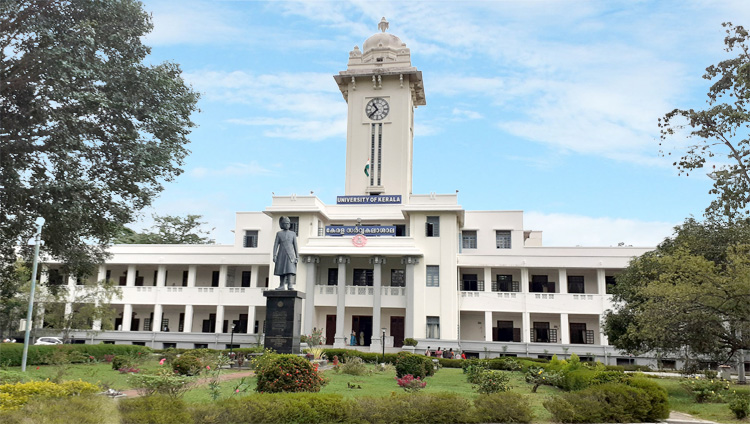
Introduction about Ph.D. in Physics at Kerala University
Kerala University stands as a beacon of scientific inquiry, offering a rigorous Ph.D. in Physics that blends theoretical foundations with cutting?edge experimental research. Designed for seasoned professionals and aspiring academicians, the program empowers candidates to explore quantum mechanics, condensed matter, astrophysics, and interdisciplinary domains. With world?class faculty, state?of?the?art laboratories, and strong industry linkages, this doctorate nurtures thought leaders who drive innovation across research labs, universities, and high?tech enterprises.
Eligibility Criteria for Ph.D. in Physics at Kerala University
Prospective scholars must meet the following baseline requirements:
- A Master?s degree (M.Sc.) in Physics or a closely related discipline with a minimum of 55% marks (or equivalent CGPA).
- For candidates with a Post?Graduate Diploma in Physics, a minimum of 60% is mandatory.
- Qualifying the university?administered entrance test or an equivalent national exam (e.g., GATE, NET).
- Proficiency in English (both written and spoken) for research documentation and presentations.
Working professionals can also apply under the Regular Evening Programme, provided they satisfy the academic thresholds and have relevant research experience.
Entrance Exam for Ph.D. in Physics at Kerala University
The entrance examination evaluates both subject mastery and research aptitude:
- Written Test (120 minutes): 100 multiple?choice questions covering Classical Mechanics, Electrodynamics, Quantum Physics, Statistical Mechanics, and Modern Physics.
- Interview & Research Proposal Presentation: Candidates present a concise research proposal and defend it before a panel of senior faculty.
Applicants who have cleared the PhD Admission Assistance program often receive valuable guidance on structuring a compelling proposal and navigating the interview process.
Fee Structure for Ph.D. in Physics at Kerala University
| Category | Annual Fee (INR) | Notes |
|---|---|---|
| General Category (Full?time) | ? 22,500 | Includes tuition, library, and lab access. |
| SC/ST/PwD Category (Full?time) | ? 15,000 | Subsidized rate per government guidelines. |
| Evening Programme (Working Professionals) | ? 30,000 | Higher fee due to extended lab hours and weekend classes. |
| Research Project Grant (Optional) | Varies (? 1?5 Lakhs) | Funded by university, ISRO, DRDO, etc., based on project scope. |
Financial support is available through merit?based scholarships, research assistantships, and external fellowships. Applicants often consult the Editing and Proofreading Services to polish grant proposals.
Admission Process for Ph.D. in Physics at Kerala University
- Online application submission through the university portal.
- Upload scanned copies of academic transcripts, degree certificates, and a detailed research proposal.
- Pay the non?refundable application fee (? 1,000).
- Appear for the written entrance test.
- Attend the interview & proposal defense.
- Receive the admission offer letter (subject to eligibility verification).
- Complete enrollment formalities, including fee payment and submission of original documents.
For assistance with the entire admission journey, many candidates benefit from the PhD Topic Selection and Proposal Assistance service.
Ph.D. Subjects and Specializations in Physics at Kerala University
Students can tailor their research across a spectrum of specializations, including:
- Quantum Optics & Quantum Information
- Condensed Matter Physics & Nanotechnology
- High Energy & Particle Physics
- Astronomy & Astrophysics
- Plasma Physics & Fusion Energy
- Biophysics & Medical Physics
- Materials Science & Computational Modelling
Interdisciplinary collaborations with the Departments of Chemistry, Mathematics, and Computer Science broaden research horizons.
Research Areas in Physics at Kerala University
Kerala University?s research ecosystem emphasizes both foundational and applied physics:
- Nanophotonics and Metamaterials
- Design of ultra?compact photonic devices for communication and sensing.
- Renewable Energy Materials
- Development of efficient photovoltaic and thermoelectric materials.
- Quantum Computing Algorithms
- Theoretical frameworks for fault?tolerant quantum processors.
- Space Weather and Solar Physics
- Modeling solar flares and their impact on satellite communications.
- Medical Imaging Techniques
- Advancing MRI and PET scan technologies through physics?based innovations.
Documents Required for Ph.D. in Physics at Kerala University
| Document | Format | Remarks |
|---|---|---|
| Academic Transcripts (M.Sc.) | PDF (Scanned) | Must be attested by the issuing university. |
| Degree Certificate (M.Sc.) | PDF (Scanned) | Original copy to be submitted later. |
| Research Proposal (5?10 pages) | Include objectives, methodology, and expected outcomes. | |
| Curriculum Vitae | Highlight publications, projects, and conference presentations. | |
| Letter of Recommendation (2) | Preferably from Ph.D. supervisors or senior researchers. | |
| Proof of English Proficiency | IELTS/TOEFL score or attested university letter. |
To ensure your documents meet the highest standards, consider the Research Publication Support for polishing manuscripts and conference abstracts.
Kerala University Ph.D. Syllabus for Physics
The syllabus is structured into three phases:
- Coursework (Year 1): Core modules ? Advanced Classical Mechanics, Electrodynamics, Quantum Theory, Statistical Mechanics, and Computational Physics.
- Comprehensive Exams (End of Year 1): Written and oral exams assessing mastery of core concepts.
- Research Phase (Years 2?4): Independent research, periodic progress seminars, and a final thesis defense.
Optional electives include Non?linear Dynamics, Laser Physics, and Environmental Physics, allowing candidates to broaden their expertise.
How To Apply for Ph.D. in Physics at Kerala University
Follow these step?by?step instructions to submit a successful application:
- Visit the official Kerala University admissions portal and create a user profile.
- Fill in personal and academic details, selecting ?Ph.D. ? Physics? as the program.
- Upload required documents (refer to the Documents Required table).
- Pay the application fee using net banking or credit card.
- Submit the proposal and await the admit card for the entrance test.
- After clearing the written test, attend the interview and provide any additional information requested.
- Upon receiving the admission offer, complete the enrollment formalities within the stipulated timeframe.
For personalized guidance throughout this workflow, students often register with the Honorary Doctorate Programs to gain mentorship from distinguished scholars.
Career Scope and Job Opportunities After Ph.D. in Physics from Kerala University
A Ph.D. in Physics unlocks a plethora of career pathways:
- Academic Positions: Assistant Professor, Associate Professor, or Lecturer in leading universities and research institutes.
- Research Scientist: Roles in government labs (e.g., ISRO, DRDO), private R&D divisions, and international research centers.
- Data Science & Machine Learning: Leveraging quantitative skills for analytics, AI, and financial modeling.
- Industrial R&D: Developing next?generation materials, photonic devices, and energy solutions.
- Science Policy & Consulting: Advising governmental and non?governmental bodies on technology strategies.








