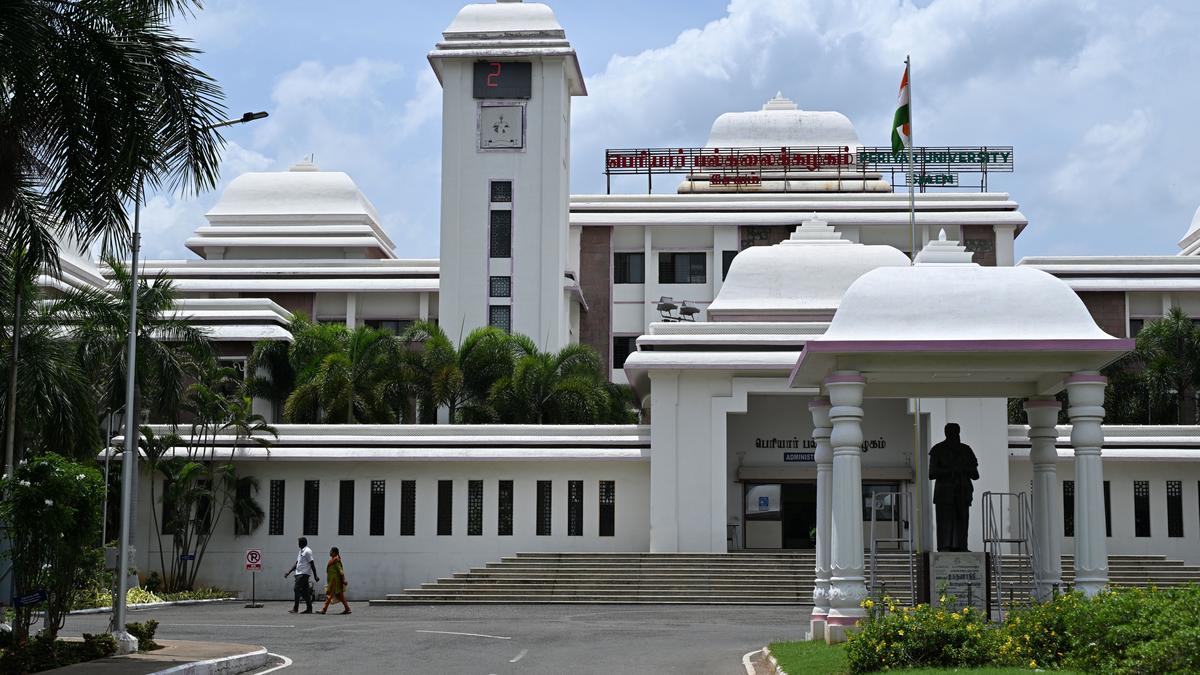
Ph.D. in Physics from Periyar University: Eligibility, Entrance Exam, Fee Structure, Admission Process, Subjects, Research Areas, Syllabus, Scholarship & Career Scope
Introduction about Ph.D. in Physics at Periyar University
The Doctor of Philosophy (Ph.D.) in Physics at Periyar University stands as a beacon for scholars eager to push the boundaries of scientific knowledge. Designed for ambitious professionals, this programme blends rigorous coursework with cutting‑edge research, fostering expertise in both theoretical and experimental domains. Whether your passion lies in quantum mechanics, condensed matter physics, astrophysics, or emerging interdisciplinary fields, Periyar University provides a vibrant academic ecosystem, state‑of‑the‑art laboratories, and mentorship from globally recognised faculty members.
Eligibility Criteria for Ph.D. in Physics at Periyar University
Prospective candidates must satisfy the following minimum requirements:
- Possess a Master’s degree (M.Sc.) or its equivalent in Physics or a closely related discipline with a minimum aggregate of 55% (50% for reserved categories).
- For candidates holding a Bachelor’s degree (B.Sc.) followed by a Master’s degree (Integrated M.Sc. or M.Sc. + B.Ed.), the cumulative percentage should meet the same threshold.
- Eligibility for candidates with a M.Phil. in Physics is also recognized, allowing direct entry into the research phase.
- Applicants must be physically fit and cleared by the university’s medical board.
Entrance Exam for Ph.D. in Physics at Periyar University
The university conducts a comprehensive entrance test, comprising:
- Theoretical Section: 120 multiple‑choice questions covering Classical Mechanics, Electromagnetism, Quantum Physics, Statistical Mechanics, and Modern Physics.
- Analytical Section: Two problem‑solving papers that test conceptual depth and mathematical rigour.
- Interview: A personal interview evaluated by a panel of senior faculty, focusing on research aptitude and motivation.
Preparation resources, previous year papers, and mock tests are regularly updated on the university portal. Candidates with a valid GATE/NET score in Physics are exempted from the written examination but must appear for the interview.
Fee Structure for Ph.D. in Physics at Periyar University
| Fee Component | Annual Amount (INR) | Notes |
|---|---|---|
| Tuition & Examination Fees | ₹12,500 | Applicable for the first two years; thereafter waived for regular progress. |
| Laboratory & Equipment Charges | ₹8,000 | Depends on the research group and project requirements. |
| Library & Digital Resources | ₹2,000 | Access to journals, e‑books, and specialised databases. |
| Annual Health & Insurance | ₹1,500 | Mandatory for all enrolled Ph.D. scholars. |
| Total Estimated Annual Fee | ₹24,000 | Subject to yearly revision by the university finance committee. |
Admission Process for Ph.D. in Physics at Periyar University
The admission cycle follows a transparent, step‑by‑step procedure:
- Online Application: Submit the digital application form through the university’s admission portal.
- Document Upload: Attach mark sheets, degree certificates, GATE/NET scores (if any), and a research proposal.
- Entrance Examination: Appear for the written test (or submit GATE/NET scores for exemption).
- Interview & Presentation: Present your proposed research topic and answer faculty queries.
- Final Selection: The Admissions Committee issues an offer letter based on merit, interview performance, and research fit.
- Enrollment: Pay the first-year fee, complete the registration formalities, and receive your university ID.
Ph.D. Subjects and Specializations in Physics at Periyar University
Students can choose from a diverse range of specializations aligned with contemporary scientific challenges:
- Quantum Mechanics & Quantum Information
- Condensed Matter Physics & Nanotechnology
- Astrophysics & Cosmology
- Particle Physics & High‑Energy Experiments
- Plasma Physics & Fusion Energy
- Optical Physics & Photonics
- Computational Physics & Data‑Driven Modelling
- Biophysics & Medical Physics
Research Areas in Physics at Periyar University
Faculty-led research clusters focus on high‑impact domains:
- Quantum Computing: Development of qubits, error‑correction algorithms, and scalable architectures.
- Renewable Energy Materials: Synthesis of perovskite solar cells and thermoelectric materials.
- Space Science: Satellite data analysis, gravitational wave detection, and exoplanetary studies.
- Advanced Spectroscopy: Ultrafast laser techniques for probing electron dynamics.
- Computational Modelling: Monte‑Carlo simulations, density functional theory, and machine‑learning‑enhanced predictions.
Documents Required for Ph.D. in Physics at Periyar University
| Document | Format | Remarks |
|---|---|---|
| Academic Transcripts (M.Sc./M.Phil.) | PDF (Scanned) | Original and verified copies only. |
| Degree Certificate | PDF (Scanned) | Must be attested by the issuing university. |
| GATE/NET Scorecard (if applicable) | Valid for the current admission year. | |
| Research Proposal (2,000‑3,000 words) | DOCX or PDF | Include objectives, methodology, and expected outcomes. |
| Curriculum Vitae | Highlight publications, conference presentations, and technical skills. | |
| Identity Proof (Aadhar/Passport) | Government‑issued photo ID. |
Periyar University Ph.D. Syllabus for Physics
The syllabus is divided into two phases:
- Coursework (Year‑1 & Year‑2): Core modules such as Advanced Classical Mechanics, Statistical Thermodynamics, Quantum Field Theory, and Research Methodology. Electives include Computational Physics, Nanostructured Materials, and Astrophysical Techniques.
- Research Phase (Year‑3 onward): Original research under a faculty supervisor, culminating in a thesis and a public defence. Students must publish at least two peer‑reviewed articles in indexed journals before submission.
How To Apply for Ph.D. in Physics at Periyar University
Follow these practical steps to submit a successful application:
- Visit the official admission portal and create a new user account.
- Fill in personal details, academic history, and select “Ph.D. – Physics”.
- Upload the required documents (as listed in the Documents Required table).
- Pay the non‑refundable application fee of ₹2,000 via net banking or credit card.
- After submission, monitor your email for examination dates, interview invitations, and final admission decisions.
Career Scope and Job Opportunities After Ph.D. in Physics from Periyar University
Graduates emerge as highly sought‑after experts in both academia and industry. Typical career pathways include:
- Academic Positions: Assistant Professor, Research Fellow, Lecturer in leading universities and research institutes.
- Industry Roles: R&D Scientist in semiconductor firms, aerospace agencies, renewable energy companies, and defense laboratories.
- Government & Public Sector: Scientist‑B positions at ISRO, DRDO, CSIR, and national laboratories.
- Data‑Intensive Careers: Quantitative analyst, machine‑learning engineer, and data scientist leveraging computational physics expertise.
- Entrepreneurship: Start‑ups focused on quantum technologies, photonic devices, or scientific consultancy.
The interdisciplinary nature of modern physics also opens doors to collaborations with biotech firms, financial institutions, and policy think‑tanks.
Scholarship for Ph.D. in Physics at Periyar University
Financial assistance is available through several schemes:
- University Merit Scholarship: Covers 100% of tuition for top‑ranked candidates.
- National Fellowship (CSIR‑JRF, UGC‑NET): Annual stipend of ₹31,000 plus contingency.
- Industry‑Sponsored Grants: Partnerships with corporations offering project‑based funding.
- Specialized Support: Funding for women researchers, SC/ST candidates, and economically weaker sections.
Applicants are encouraged to explore external funding opportunities such as Thesis and Dissertation Writing Services for assistance in preparing grant proposals and project reports.
FAQs Regarding Ph.D. in Physics at Periyar University
- 1. What is the minimum duration to complete the Ph.D.?
- The programme is structured for a minimum of 4 years, with a maximum of 6 years allowed for completion. <








